Are Tennis Balls Safe for Dogs? The Hidden Dangers Vets Want You to Know
Are Tennis Balls Safe for Dogs?
The Hidden Dangers Vets Want You to Know
A few weeks ago, an independent pet retailer shared something with us that stopped us cold. We’ve been in the dog business for over 20 years. We’ve heard a lot. But we weren’t ready for this one.
The Story That Changed Everything
A woman walked into an independent pet shop in Iowa. She wasn’t browsing. She wasn’t shopping. She was there to tell the shop owner something that had just shattered her world.
Her dog — a young, healthy Malinois — was dead. Tetanus.
Not from a rusty nail. Not from a puncture wound on a hike. From a tennis ball.
The local vet had missed it. By the time the dog was transferred to Iowa State University’s Veterinary Teaching Hospital, the veterinarians there identified the cause almost immediately. The dog had a damaged tooth. Tetanus bacteria — Clostridium tetani, which lives in soil virtually everywhere — had entered the dog’s system through that one compromised tooth.
And then it happened again. A second young dog in the same area. Same diagnosis. Same cause. Same outcome. Both dogs had damaged teeth. Both dogs had been playing with tennis balls.
Two dogs. Two families. Both devastated. Both blindsided by something sitting in millions of toy boxes across America right now.
“ISU said because tennis balls have that sponge-like texture, bacteria can easily get and stay on them. Tetanus, like many other nasty things, is everywhere in the ground. Tennis balls just collect all that stuff.”
— INDEPENDENT PET RETAILER, IOWA
Here’s what the veterinarians at ISU explained: the felt-like texture on a tennis ball acts like a sponge. Every time the ball hits the ground — every roll through the grass, every landing in the mud, every fetch in the yard — that felt is collecting dirt, moisture, and bacteria from the soil. And it holds onto them. Deep in the fibers, where a rinse under the faucet will never reach.
Every time a dog picks up that ball, everything the felt has collected goes straight into their mouth.
Now here’s the part that makes it truly insidious: the same felt that collects the bacteria also destroys the teeth. Veterinarians call it “tennis ball mouth” — a documented condition where the abrasive felt wears down tooth enamel over time. Worn enamel means exposed dentin. Exposed dentin means cracks, sensitivity, and small wounds in the tooth structure. And those small wounds? They’re the open door. The bacteria that the tennis ball delivered are now entering the bloodstream through damage that the tennis ball caused.
The tennis ball creates the wound. The tennis ball delivers the infection. One toy. Both sides of the equation.
The pet retailer who shared this story with us said something that stuck: “And this would be another reason why I do NOT sell tennis balls in my shop.”
She’s not alone. More and more independent pet retailers and veterinarians are pulling tennis balls from their shelves entirely. Not because of a trend. Because of what they’re seeing.
We’ve spent over 20 years building products around one belief: what goes into your dog’s mouth matters. Hearing that a dog actually died because of a tennis ball didn’t surprise us. But it hit different. It hit personal.
So we dug into the research. And what we found is something every dog owner needs to see.
“The felt coating on a tennis ball acts like sandpaper, gradually wearing down teeth in a process called ‘blunting.’ This thinning exposes the sensitive dentin layer beneath, increasing the risk of dental pain, infection, and tooth fracture.”
— BOARD-CERTIFIED VETERINARY DENTAL SPECIALISTS
· · 🐾 · ·
The 5 Hidden Dangers of Tennis Balls for Dogs
Most people think of tennis balls as harmless. They’re everywhere — at the park, in pet store bins, rolling around the house. But tennis balls were designed for tennis courts, not for dogs. And that distinction matters more than most people realize.
🦷 DANGER #1
Dental Damage: “Tennis Ball Mouth” Is a Real Diagnosis
Veterinary dental specialists have a name for it: tennis ball mouth.
The felt coating on a tennis ball might feel soft to us, but under a microscope, it’s abrasive — and it gets worse over time. As the ball picks up dirt, sand, gravel, and grit from the ground, that felt becomes the equivalent of sandpaper. Every time your dog chomps down, the felt grinds against their teeth.
Over weeks and months of regular chewing, this wears down the enamel in a process called “blunting.” The teeth become visibly flattened. In severe cases, you can actually see tennis-ball-shaped grooves worn into the surface of a dog’s teeth.
Once the enamel is gone, the sensitive dentin layer underneath is exposed. This means significant pain, difficulty eating, increased risk of tooth fracture, and — critically — it creates entry points for bacteria. Including, as we now know, tetanus.
The American Kennel Club, board-certified veterinary dentists, and veterinary hospitals across the country have all flagged this as a significant and growing concern.
🦠 DANGER #2
A Breeding Ground for Bacteria
This is the part that connects directly to the story from Iowa.
Tennis ball felt doesn’t just pick up dirt — it absorbs and holds moisture, creating an environment where bacteria can thrive. Clostridium tetani, the bacterium that causes tetanus, lives in soil virtually everywhere and can survive in the ground for up to 40 years.
Every time a tennis ball hits the ground, rolls through grass, lands in mud, or sits in a wet yard, it’s collecting bacteria. Unlike a smooth, non-porous surface that can be rinsed clean, the fibrous felt texture traps contaminants deep within its fibers where a simple rinse won’t reach them.
Your dog picks up that ball, and everything the felt has collected goes directly into their mouth. If they have a worn tooth, a small cut on their gums, or any dental damage — which, ironically, the tennis ball itself causes over time — those bacteria now have a pathway into the body.
It’s a vicious cycle: the tennis ball wears down the teeth, the worn teeth create entry points, and the same tennis ball delivers the bacteria.

Left: Tennis ball felt under close inspection — porous fibers trapping dirt and moisture. Right: Smooth natural rubber — non-porous, rinses clean.
⚠️ DANGER #3
A Serious Choking Hazard
A strong dog can compress a tennis ball in its jaws. When the dog opens its mouth, the ball can spring back to full size — and if it’s at the back of the throat when that happens, it can completely block the airway.
Dogs have died from this. It can happen in seconds, and it’s nearly impossible to dislodge without veterinary intervention.
Beyond the whole ball, dogs that chew through the felt and rubber create small fragments that can be swallowed. These fragments can cause intestinal blockages that require emergency surgery.
Dr. Marty Becker, one of the most widely known veterinarians in the country, has cautioned that dogs should never have unsupervised access to tennis balls — and should never have more than one at a time, precisely because of this risk.
🧪 DANGER #4
Chemicals, Glue, and Dyes Not Made for Dogs
Here’s something most dog owners don’t consider: tennis balls are manufactured for a sport, not as a pet product. That means they are not subject to any pet safety standards whatsoever.
The rubber core, the felt coating, the glue that bonds them together, and the dyes that give them that familiar neon yellow color — none of these materials were chosen with a dog’s mouth in mind. Veterinary experts have raised concerns about potential exposure to chemicals including formaldehyde in adhesives, synthetic dyes, and chemical coatings used to enhance durability on a tennis court.
There have also been reports of lead being found in the printed logos and branding on some tennis balls. Whether or not that specific claim holds up universally, the broader point stands: these are unregulated materials going into your dog’s mouth multiple times a day.
When you’re choosing something your dog is going to put in their mouth every single day — sometimes for hours — the materials matter.
💀 DANGER #5
They Fall Apart — By Design
Tennis balls are designed to be replaced after a few sets of tennis. They’re consumable products with a short intended lifespan. But dog owners often use them until they’re shredded, which means dogs are chewing on increasingly degraded materials — exposed glue, loose felt fibers, crumbling rubber — for weeks or months.
A fetch toy for a dog needs to be built to survive a dog. Tennis balls simply aren’t.
“There are no standards for the materials used in the manufacturing process and undoubtedly toxic chemicals are used — from the rubber ball, to the fuzzy coating, to the glue that holds it all together.”
— SIERRA VETERINARY HOSPITAL
· · 🐾 · ·
What the Experts Are Actually Saying
The American Kennel Club advises that tennis ball fuzz “acts like sandpaper, gradually wearing down teeth” and warns about both choking hazards and chemical concerns.
Board-certified veterinary dental specialists have documented “tennis ball mouth” as a clinical condition, with cases showing severe enamel loss directly attributed to tennis ball chewing.
Sierra Veterinary Hospital states that there are no safety standards governing the materials in tennis balls — and that toxic chemicals are undoubtedly present in their construction.
Iowa State University Veterinary Teaching Hospital identified tennis ball contamination as the pathway for tetanus infection in at least two documented cases, linking the felt texture’s ability to harbor soil-borne bacteria with dental damage as the entry point.
The pattern is clear: tennis balls damage teeth, harbor bacteria, pose choking risks, and expose dogs to unregulated chemicals. Any one of these would be reason to reconsider. Together, they paint a picture that’s impossible to ignore.
· · 🐾 · ·
What to Look for in a Safe Fetch Toy

If tennis balls are out, what should you look for? Here’s what veterinarians recommend:
Material matters. Look for 100% natural rubber — no synthetic compounds, no adhesives, no felt coatings. Natural rubber is non-toxic, durable, and doesn’t harbor bacteria the way porous materials do.
Smooth, non-porous surface. A smooth surface can be rinsed clean after every session. Unlike felt, it won’t trap dirt, moisture, or bacteria in tiny fibers.
Sized correctly for your dog. The ball should be large enough that your dog can’t compress it to the back of their throat, but small enough to comfortably carry. One size does not fit all.
Built to last. A good fetch toy shouldn’t fall apart after a few sessions. Look for something designed for dogs from the ground up — not repurposed from another sport.
No BPA, no phthalates, no synthetic dyes. If the manufacturer can’t tell you exactly what’s in their product, it shouldn’t go in your dog’s mouth.
· · 🐾 · ·
🐶 THE SAFER ALTERNATIVE · BUILT FOR DOGS FROM DAY ONE
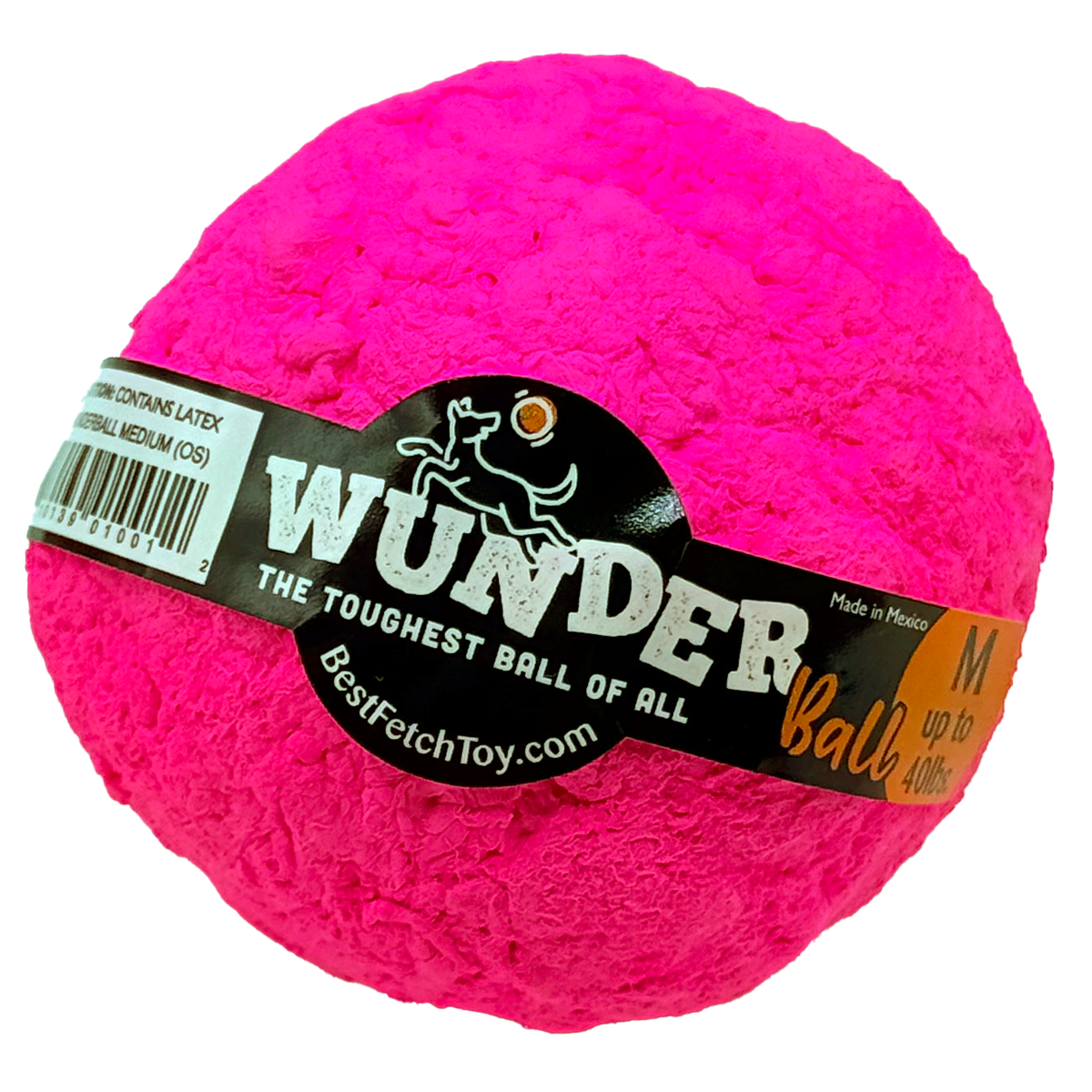
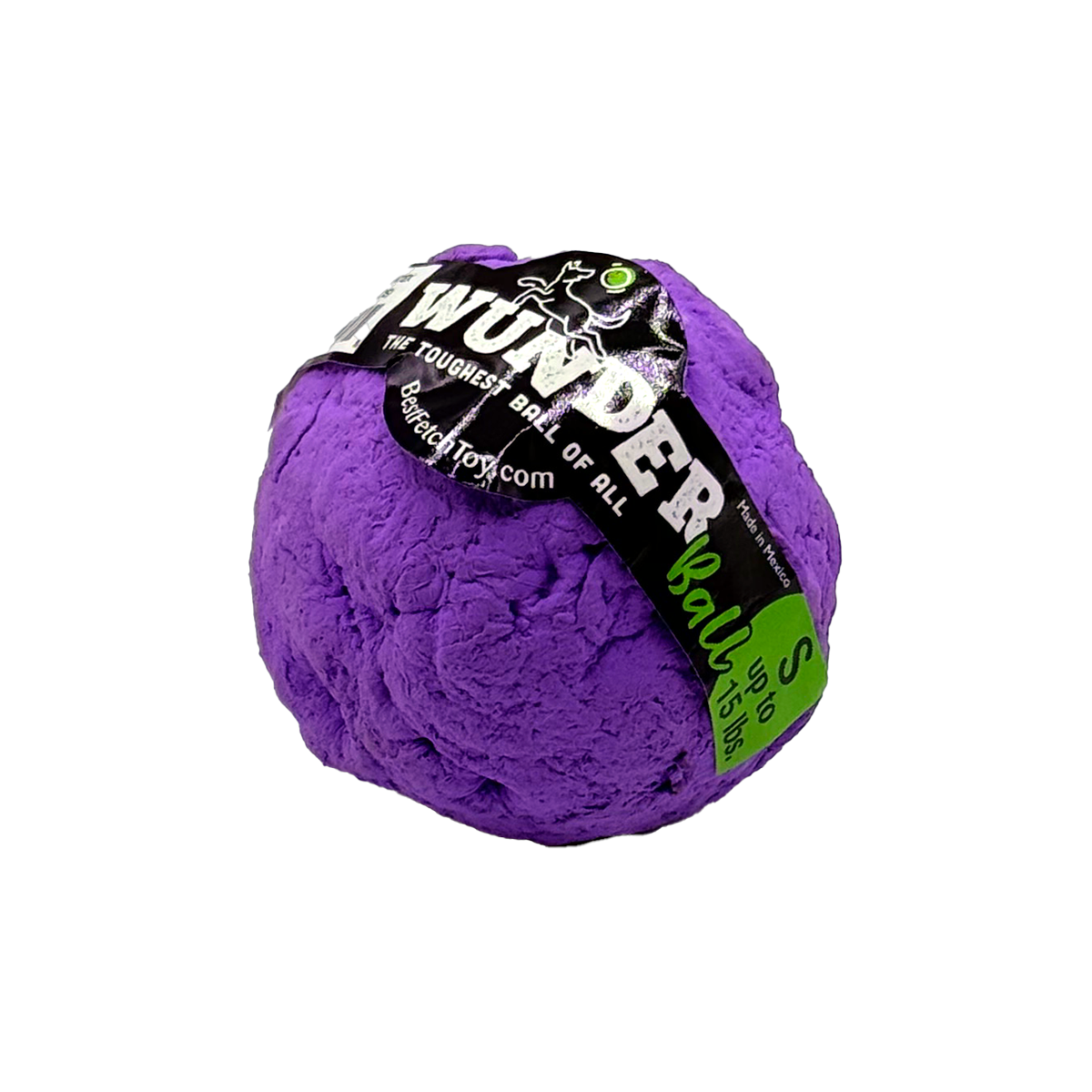
WUNDERball
100% NATURAL RUBBER · HANDMADE · NO JUNK · NO SHORTCUTS
We started making the WUNDERball in 2019 because we believed dogs deserved a fetch toy as safe and intentional as our leashes. Every WUNDERball is handmade from 100% natural rubber — no BPA, no phthalates, no synthetic dyes, no felt coating, no glue, no shortcuts. Each one is poured, cured, shaped, and packed by hand. No machines. No molds. No two exactly alike.
- Smooth natural rubber surface — doesn’t trap bacteria the way felt does. Rinses clean with water.
- Virtually indestructible — built to survive your dog, not fall apart after a few sessions.
- Unpredictable bounce — the irregular, handmade shape creates a bounce that drives dogs wild and keeps fetch exciting.
- Bright neon color — visible in tall grass, snow, low light, and dark water.
- Floats — take fetch to the lake, the pool, or the beach.
- Four sizes — Small (up to 15 lbs), Medium (up to 40 lbs), Large (up to 80 lbs), XL (over 80 lbs). Because safety isn’t one-size-fits-all.
📏 WUNDERBALL SIZE GUIDE
Choose the Right Size for Your Dog
Always size to your dog’s current weight. A ball that’s too small for your dog’s mouth is a choking hazard — when in doubt, size up.
· · 🐾 · ·
The Bottom Line
Tennis balls were made for tennis. Your dog deserves something made for them.
If the felt is wearing down your dog’s teeth, if the bacteria trapped in that fuzzy coating is putting them at risk, if the chemicals were never tested for pet safety, and if the whole thing can become a choking hazard in a matter of seconds — why take the chance?
We’re not asking you to take our word for it. We’re asking you to listen to the veterinarians, the dental specialists, the AKC, and the pet retailers who have stopped selling tennis balls entirely.
Then make the switch.

This is what safe fetch looks like. 100% natural rubber. Handmade. No junk. No shortcuts.
🐾 MAKE THE SWITCH
Everything Your Dog Needs for Safer Fetch
A fetch toy built for dogs — not borrowed from a tennis court. 100% natural rubber. Handmade. Four sizes. No junk.
· · 🐾 · ·
Frequently Asked Questions
Are tennis balls safe for dogs?
No. Veterinarians increasingly warn against tennis balls for dogs. The felt coating causes dental wear (“tennis ball mouth”), the porous texture harbors bacteria from the ground, the ball can compress and become a choking hazard, and the materials — including adhesives and dyes — are not regulated for pet safety. A natural rubber fetch toy like the WUNDERball is a significantly safer alternative.
Can tennis balls cause infections in dogs?
Yes. Iowa State University’s Veterinary Teaching Hospital documented cases where dogs contracted tetanus through dental damage caused by — and bacteria delivered by — tennis balls. The felt texture traps soil-borne bacteria including Clostridium tetani, and worn or damaged teeth provide an entry point into the bloodstream.
What is “tennis ball mouth”?
Tennis ball mouth is a term used by veterinary dental specialists to describe the dental wear caused by regular tennis ball chewing. The abrasive felt, combined with trapped dirt and grit, acts like sandpaper on a dog’s teeth, gradually wearing down the enamel in a process called “blunting.” In severe cases, tennis-ball-shaped grooves are visible on the teeth.
What is a safer alternative to tennis balls for dogs?
Look for a fetch toy made from 100% natural rubber with a smooth, non-porous surface that won’t trap bacteria. It should be sized correctly for your dog’s breed and weight, contain no BPA, phthalates, or synthetic dyes, and be built to last. The WUNDERball checks every one of these boxes and has been handmade in North America since 2019.
What size WUNDERball should I get?
Size based on your dog’s weight: Small for up to 15 lbs, Medium for up to 40 lbs, Large for up to 80 lbs, and XL for over 80 lbs. When in doubt, size up — a ball that’s too small is a choking hazard.
How do I clean a WUNDERball?
Simply rinse with water. The smooth natural rubber surface is non-porous, which means dirt, bacteria, and moisture can’t get trapped the way they do in tennis ball felt. A quick rinse after each session is all it takes.