Using Treats in Fetch Training: How to Build a Reliable Retrieve Without Bribery
Using Treats in Fetch Training: How to Build a Reliable Retrieve Without Bribery
The dog that actually brings the ball back isn't the one who's been bribed into it. She's the one who has been paid, on the right schedule, with the right currency.
Most fetch "failures" have nothing to do with the dog. They have to do with timing, reward hierarchy, and a handler who is quietly teaching the wrong behavior. The good news: once you fix those three variables, a reliable retrieve usually shows up in a week or two.
This is the method professional positive-reinforcement trainers use, rewritten for a regular weeknight in the backyard. You'll learn the difference between bribery and reinforcement, how to set up a two-tier reward system that doesn't empty your treat jar, and a five-step sequence for teaching any dog — adult or puppy — to chase, return, and release the ball.

Bribery vs. Reinforcement
The line between them is the half-second between behavior and reward. Bribery shows the treat before the dog performs; the dog works for the sight of the cookie. Reinforcement delivers the treat after the behavior is already happening; the dog works for the surprise of the payoff.
It sounds like a small distinction. In practice, it's the difference between a dog who only fetches when you're holding the bag and a dog who fetches because fetching is what she does.
Treat as lure
You wave a treat to get the dog to drop the ball. She learns: "If I hold out, a treat appears." The treat is load-bearing. The second it's gone, so is the behavior.
Treat as consequence
The dog drops the ball because she's been trained to. Then the treat comes — sometimes. The behavior stands on its own. The treat makes it stronger over time.
Every technique in this article is built on that second column. The goal is always a dog who fetches because she loves it and trusts you to pay when the work is worth paying for — not because you're dangling dinner.
The Two-Tier Reward System Pro Trainers Use
Here's the mistake new owners make at the treat jar: they try to pay for every single rep with the same fancy cookie. Within a week they've spent $40 on treats, the dog is getting full by rep ten, and the behavior still isn't solid.
Professional trainers don't do that. They use a reward hierarchy — a low-value, high-frequency reward for the grind of the session, and a high-value "jackpot" reward that shows up occasionally for the moments that matter most. The jackpot is what consolidates learning. It's the reason your dog will keep trying on rep thirty.
The Everyday Paycheck
Low-value, high-frequency
Pieces of your dog's regular kibble, small store-bought training bits, or a few crumbs of chicken. Pea-sized. Cheap. You'll use twenty or thirty of these in a single session. This is your rep-by-rep currency — enough to mark the behavior, small enough that the dog stays hungry for more.
The Jackpot
High-value, rare, unforgettable
A single premium treat snapped cleanly in half right in front of your dog — this is where WUNDERtreats earn their keep. Oven-baked, real ingredients, the kind of treat your dog already loses her mind for. Reserved for the breakthrough moment of the session: the first clean release, the longest retrieve, the rep you most want to consolidate.
Use this system and your training treats last. The dog who got one pea-sized piece of kibble for rep after rep and then got an actual piece of WUNDERtreat for the best rep of the day will remember the jackpot rep forever. That's what builds reliability.
How to Teach a Dog to Fetch in 5 Steps
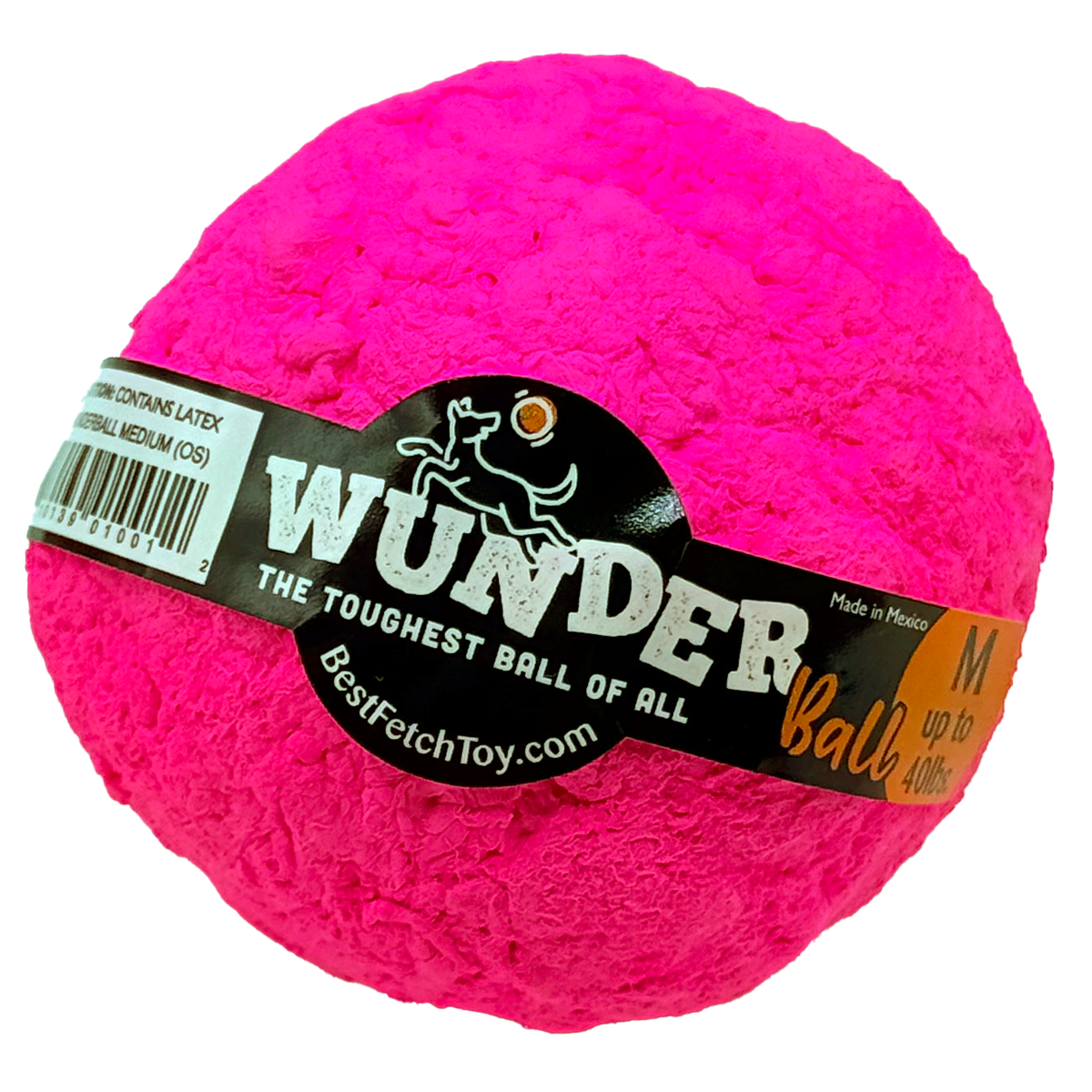
Keep sessions short — five to ten minutes, twice a day at most. Train before meals so your dog is motivated. Pick a quiet space with no other dogs. And bring both tiers of treats, plus one great ball. The WUNDERball is designed for exactly this — an unpredictable bounce that triggers prey drive even in dogs who have "never liked fetch."
-
Make the ball interesting
Before you throw anything, make the ball the best thing in the room. Roll it back and forth between your hands on the ground. Tease with it. When your dog moves toward the ball, mark with a cheerful "yes!" and reward with a Tier 1 treat.
You're not asking for a retrieve yet. You're teaching one thing only: the ball means good things happen. This step takes one or two sessions for most dogs.
-
Short toss, then trade
Toss the ball two or three feet. The moment your dog picks it up, calmly show her a Tier 1 treat and say "drop." When she spits the ball to eat the treat, say "yes!" and pay.
This is the step where ninety percent of new owners go sideways: they chase the dog to get the ball back. Don't. Stand still, look relaxed, and let the trade happen on your terms.
-
Reward the return, not the retrieve
Here's the counterintuitive part. Don't reward your dog for picking up the ball. Reward her for bringing it toward you. The instant she turns back in your direction with the ball, mark "yes!" and pay as soon as she arrives.
The retrieve is the default behavior dogs already have — chase, grab, bring to base. Your job is to reinforce the "bring to base" half, which is the half most handlers accidentally skip.
-
Stretch the distance
Once your dog returns reliably from three feet, throw four. Then six. Then ten. Keep the throws short enough that you almost never fail — success is the reinforcer. If she drops the ball halfway or gets distracted, shorten the next throw.
Don't move to a longer distance because you're bored. Move when she is succeeding ninety percent of the time at the current one. This is how reliability is actually built.
-
Jackpot the breakthrough
Watch for the rep that's better than the others — the longest return, the cleanest drop, the first time she beats you back. Don't pay it with a regular treat. Pay it with a jackpot.
Snap a WUNDERtreat cleanly in half in front of her — they break by hand with a satisfying crack, and the ritual of the break itself builds anticipation. Hand-feed each half slowly, saying "good girl, good girl" between them. Then end the session. Always leave the dog wanting one more round. That's the rep she will remember next time.

Teaching a Puppy to Fetch
The method is the same. The expectations are smaller. A puppy's attention span is about ninety seconds at a time — so run three ninety-second sessions a day, not one ten-minute one. Skip the long throws. Work indoors on a hallway runway where the ball can't roll away from you.
Most puppies love step one (ball on floor, chase) and fall apart at step two (trade for a treat). That's normal. Puppies haven't figured out that the treat is better than the ball yet. Spend a week on step two alone if you need to. The retrieve will come, and when it does, it'll be clean, because you built it slow.
For pup-specific technique, the AKC's puppy fetch guide is a solid second opinion. And if you want to go deeper on the science of why positive reinforcement beats correction-based methods, Karen Pryor's primer on operant conditioning is the reference the rest of us quote from.
When It's Not Working
Your dog runs with the ball but won't bring it back
Switch spaces. You're probably in a yard that's too big. Go to a hallway or a six-foot long-line in an open field. She isn't disobeying — she's just found a better game called "keep-away." Shrink the distance until bringing it back is the shortest path to the jackpot.
She drops the ball halfway and stares at you
You've been rewarding the pickup, not the return. Stop paying until the ball is in your hand. Say nothing — just walk backward a step or two. Nine times out of ten she'll pick it up and finish the trip.
She's bored after three throws
The ball isn't engaging enough, or the session is too long. The WUNDERball's asymmetric shape was designed for exactly this — it doesn't roll the same way twice, which keeps dogs tracking. If you already have one and she's still tuning out, shorten the session and end on a jackpot.
She only fetches when you have the treat bag visible
Classic bribery drift. Start fading the bag: tuck it in a pocket, leave it on a porch step, walk to it after the successful rep. The reward still comes — just not from the hand the dog was watching.
WUNDERtreats
Oven-baked, real ingredients, saved for the reps that matter.
Two flavors — Peanut Butter & Blueberry and Sweet Potato & Honey — made with whole oat flour, farm eggs, and real peanut butter or sweet potato. Oven-baked in small batches in North America. These aren't designed to be your rapid-fire training currency; they're the premium treat you snap cleanly in half by hand to mark a breakthrough. Your dog will know the difference.
Shop WUNDERtreats
Everything in this article, bundled and discounted.
Two WUNDERballs (in case one gets lost behind the couch) plus two bags of WUNDERtreats — one of each flavor — for fifteen percent less than buying them separately. The ball solves the chase. The treats solve the return. Together, they're the whole method.
Get The Bundle — 15% OffFrequently Asked Questions
How many treats should I bring to a fetch session?
For a ten-minute session: twenty to thirty Tier 1 pieces (kibble or small training bits) and one WUNDERtreat set aside as your jackpot. Err on the side of having more Tier 1 pieces than you think you'll need — running out mid-session tanks momentum.
My dog isn't food motivated. Does this still work?
Food motivation is a spectrum, not a switch. Try training before a meal when she's actually hungry. Switch your Tier 1 reward to something higher-value like real chicken. And remember that for many ball-driven dogs, getting the WUNDERball thrown again is itself a reward — you don't always need food to reinforce.
Can I teach fetch with just treats and no toy?
No. Fetch is a chain of behaviors — chase, grab, carry, release — and you need an object to chain them around. The toy is the context. Treats are the paycheck for performing well inside that context.
What if my dog swallows the ball?
Size up. The WUNDERball comes in sizes calibrated by dog weight, and picking the right one is non-negotiable. A ball that's too small is a choking hazard for any dog, full stop. If in doubt, go one size up.
Are WUNDERtreats healthy as training rewards?
Yes — real ingredients, oven-baked, no fillers. That said, veterinarians recommend treats make up no more than ten percent of daily calories. WUNDERtreats are premium biscuits sized to snap cleanly in half by hand, so one treat typically covers one or two breakthrough rewards per session. If you want to stretch a treat further, a quick knife-cut into three or four pieces works too.
Skip the Trial and Error. Start With the Kit.
The Fetch & Reward WUNDERbundle has the ball professional trainers use and the treats worth breaking in half for — together, fifteen percent off.
Claim the Bundle